
FDR signing the 1935 SS Act (click image for person key)
Wednesday, July 29, 2015


Saturday, July 4, 2015

Saturday, May 31, 2014
2014 Social Security Trustees Report is Just Around the Corner
And about time, because under the statute if is due "no later than April 1". But I am told on good authority that it will be out this week or maybe next. But eventually.
So I am setting up a new resource at a Google Page attached to this account which has the URL:
https://plus.google.com/+SocialsecuritydefenderBlogspot1935/about
It is underdeveloped right now but does have links to two different Public Folders on the Social Security Defender Google Drive. One of which will be the repository for a whole series of Excel spreadsheets containing the various Tables of the 2014 Report extracted from the PDF and HTML versions released by the Office of the Actuary. Already there is a sample there of a single Excel Workbook with five Worksheets containing five different Tables from the 2013 Report.
While the files should be read only, there should be no limit on them being imported or copied into your own Excel spreadsheet or for that matter Google Sheets or Apple Numbers. If anyone actually stumbles accross this message and tries it and for some reason it doesn't work feel free to e-mail me at the contact e-mail on the linked page.
Hopefully I will be populating the Google Drive folders and so the Google+ Page with new material soon after the Report release.
So I am setting up a new resource at a Google Page attached to this account which has the URL:
https://plus.google.com/+SocialsecuritydefenderBlogspot1935/about
It is underdeveloped right now but does have links to two different Public Folders on the Social Security Defender Google Drive. One of which will be the repository for a whole series of Excel spreadsheets containing the various Tables of the 2014 Report extracted from the PDF and HTML versions released by the Office of the Actuary. Already there is a sample there of a single Excel Workbook with five Worksheets containing five different Tables from the 2013 Report.
While the files should be read only, there should be no limit on them being imported or copied into your own Excel spreadsheet or for that matter Google Sheets or Apple Numbers. If anyone actually stumbles accross this message and tries it and for some reason it doesn't work feel free to e-mail me at the contact e-mail on the linked page.
Hopefully I will be populating the Google Drive folders and so the Google+ Page with new material soon after the Report release.
Wednesday, November 20, 2013
New(?) and Improved(???) Social Security Defender Blog
Well I am going to try to build out the Social Security Defender account to integrate some of the new possibilities for sharing info on the defense. But first the components.
socsec.defender@gmail.com is the underlying Google Account and the main e-mail for all things Social Security by account/blog owner/admin Bruce Webb
Like all G-mail accounts there is an associated Google Drive cloud storage. And a Google+ site. But also I set up a SocialSecurityDefenders Google Group. Along with this Social Security Defenders blog. And in principal all of this can be combined and cross authorized with varying levels of permissions. But all of that is devilishly difficult to coordinate.
My inclination is to use the SocialSecurityDefenders Group to grant the fullest access to the account Google Drive and to use a subset of that as Editors of the Social Security Defenders blog.
Presumedly all Group members would also be in a Circle on the Google+. And then both the Google Drive and the Google+ site would have some parts and folders shared with the Public.
But getting everyone in at the right level might mean some getting unwanted e-mail traffic and others getting the equivalent of an 'un-friending' So apologies in advance as things get sorted out.
Bruce, aka Social Security Defender
socsec.defender@gmail.com is the underlying Google Account and the main e-mail for all things Social Security by account/blog owner/admin Bruce Webb
Like all G-mail accounts there is an associated Google Drive cloud storage. And a Google+ site. But also I set up a SocialSecurityDefenders Google Group. Along with this Social Security Defenders blog. And in principal all of this can be combined and cross authorized with varying levels of permissions. But all of that is devilishly difficult to coordinate.
My inclination is to use the SocialSecurityDefenders Group to grant the fullest access to the account Google Drive and to use a subset of that as Editors of the Social Security Defenders blog.
Presumedly all Group members would also be in a Circle on the Google+. And then both the Google Drive and the Google+ site would have some parts and folders shared with the Public.
But getting everyone in at the right level might mean some getting unwanted e-mail traffic and others getting the equivalent of an 'un-friending' So apologies in advance as things get sorted out.
Bruce, aka Social Security Defender
Saturday, January 5, 2013
Trust Funds, Chained CPI and Debt Limits
(Cross posted from dKos)
Well let's start where my last diary ended up: Debt Toolkit: Public, Subject to the Limit, Social Security Trust Fund and put those tools to work starting from the same screen shot from Treasury's Debt to the Penny web application.
 To recap: by law since their foundation in 1939 (OAS) and 1956 (DI) the Social Security Trust Funds have been required to hold all income in excess of current cost in the form of financial instruments fully guaranteed as to principal and interest by the federal government, which in practice means Treasuries. The specific Treasuries held by the Trust Funds are called Special Issues and have some unique features but are legal obligations of the U.S. fully backed up by Full Faith and Credit of the United States. As such the $2.6 trillion in the Trust Funds are held on the books at Treasury as just over half of the $4.8 tn of 'Intragovernmental Holdings' in the screen shot and so right on 1/7th of the $16.4 tn of Total Public Debt Outstanding. And importantly, and as shown in the last diary, an equal amount of Debt Subject to the Limit, that same $16.4 tn.
Since Trust Fund assets are over half of Intragovernmental Holdings and those Holdings are included in Debt Subject to the Limit it follows that ANY increase in Trust Fund assets puts pressure on the Debt Limit. Now Trust Fund assets grow in any year where income from all sources, including interest credited to the existing TF assets, exceeds current cost. For example in 2011 Social Security operations on a combined basis were as shown in this linked Table from the 2012 Social Security Report: Table III.A3.—Operations of the Combined OASI and DI Trust Funds, Calendar Year 2011 The literal top line shows cumulative assets of $2.608 (fixed typo) trillion as of Dec 31, 2010, the bottom line $2.678 trillion on Dec 31, 2011. This difference of $69 billion in assets added directly to Intragovernmental Holdings and so directly into Total Public Debt Outstanding and Debt Subject to the Limit.
Now it is a fact that this increase in assets is net of interest credited, on a cash flow basis Social Security was actually negative as a portion of the $114 billion in interest earned on existing Trust Fund assets had to be paid in the form of cash. Now one can argue whether this is a problem for taxpayers or not, after all the money comes from somewhere, but for the purposes of deficit and debt scoring that cash flow fact is irrelevant. In 2011 Social Security ran a surplus of $69 billion which subtracted directly from the unified budget deficit. At the same time that $69 billion flowed right to the bottom line of Total Public Debt. Meaning that as regards Social Security the common sense idea that debt is simply the sum of deficits is totally reversed. Social Security surpluses add to debt and don't subtract from it.
And of course the reverse is true. If you want to reduce the pressure exerted by Intragovernmental Holdings on Debt Subject to the Limit you would want to REDUCE Trust Fund Assets. And given that growth in those assets is directly the result of income from all sources exceeding cost, the only way to reduce that growth is to either cut income or increase benefits. Which leads to the rather astonishing result that over the short run and in specific regards to Debt Limit calculations proposals to means test Social Security and/or impose a new COLA formula via Chained-CPI are arithmetically COUNTERPRODUCTIVE, they tend to put pressure on the Debt Limit and not relieve it.
Now this doesn't mean that it is totally irresponsible to address long term solvency issues in Social Security, but dragging them into a specific debate over the Debt Limit is pure blackmail, the 'solutions' the Republicans are demanding have literally less than zero to do with the vehicle which they are using to demand them. Now it is not true (as some supporters would have it) that Social Security has no effect on deficits or in our case debt, because it does. But in ways that go against 'common sense'.
Cutting Social Security cost does less than zero to reduce either short term or long term Public Debt, instead any such cuts either increase that Public Debt or in some formulations (which personally I don't agree with, but are pushed by people smarter than me) leave it unchanged on net.
On the other hand Social Security benefit cuts or alternately revenue increases do serve to reduce so called unfunded liability. But unfunded liability is not debt. And for that matter is not legally a liability. Instead it is a purely theoretical calculation of the Present Value of the gap between Scheduled and Payable benefits under Social Security, something I discussed in my diary from Monday Social Security Rashomon: an Actuary, a Defender and a Reformer Meet
Now I am perfectly happy to talk for hours and days about Unfunded Liability over either the 75 year actuarial window or even over the (God Help Us) Infinite Future Horizon. Fun stuff!!! But neither that 'Liability' or that Horizon have any direct relevance to either 10 year budget windows or the current Debt Limit. And only fools or liars will tell you different. Or to summarize: House Republicans.
Thursday, January 3, 2013
2013 Debt and Deficit Toolkit: Part 1
(Crossposted from Angry Bear
All of the terms in the post title have at least two usages, some of which map upon to common sense ideas from business or household budgeting, some not. Unfortunately the usages that don't tend to be those used in federal budget reporting, and the result is untold confusion. Now one way out would be to listen to me. Then again the relevant line on my CV under 'Budget Reporting' reads 'Some Guy', 'U of Intertoobz'. So really the only way out is to start to build your own Budget, Debt and Deficit Toolkit. And this post is intended to give you a start using sources provided by the official scorekeepers of such things: the U.S. Treasury, the Congressional Budget Office (CBO), the President's Office of Management and Budget (OMB) and the Joint Committee on Taxation (JCT).
First stop is the U.S. Treasury Department's Bureau of Public Debt and their web application Debt to the Penny. This handy application allows you to track Total Public Debt and its two components Debt Held by the Public and Intragovernmental Holdings to the literal penny as of the close of the daily books the last business day but one. That is if you check the site on Tuesday it will give you final numbers for Friday. And a search today gave me the results for Monday the 31st (since Tuesday was a Federal Holiday) with Total Public Debt of $16,432,730,050,569.12 . This number is almost exactly the same as Debt Subject to the Limit differing only in the last seven or eight digits, which change so fast that you wouldn't be able to see the difference. Debt Subject to the Limit is set by Congress and under current law is $16.394 trillion. With the result shown in the following official graph Debt Subject to the Limit Graph which shows total Public Debt Subject to the Limit (dark blue) passing through the Limit (orange) on the 31st.
Without comment (we are just building a toolkit here) we can move from Debt to Deficit. Here things get more complicated but probably the simplest tool available to us from official sources is found in CBOs annual The Budget and Economic Outlook: Fiscal Years 2012 to 2022 and the literal top line numbers from that is Summary Table 1 (click to embiggen)
 Note that in this Summary table the bolded words Deficit (-) or Surplus unmodified by any adjective are unequivocably the sum of 'On-budget' and 'Off-budget' surplus/deficit. This isn't the only usage of 'deficit' in CBO reporting, and in a weird twist of terminology is NOT the same as what they call 'primary deficit', but it is a fair equivalent to what both CBO and the MSM term 'THE deficit'. For example take a standard news story from just today FY2011 Federal Deficit = $1,299,000,000,000 or just a minor update of the figure from the Table.
I'll flesh out some of the implications of this in Comments and in later posts but will leave with two points. One almost the entirety of the 'Off budget' surplus of $67 billion is the result of an increase in assets of the Social Security Trust Fund. It is NOT a measure of cash flow nor does cash flow measure into it. Two the claim that 'Social Security doesn't contribute to the deficit' is not quite right. It can and does contribute to the bottom line. But in either positive (surplus) or negative (deficit) directions. And in 2011 a cash flow negative Social Security Trust Fund ran a surplus for the purposes of THE federal deficit as defined.
More tools and more discussion later.
First stop is the U.S. Treasury Department's Bureau of Public Debt and their web application Debt to the Penny. This handy application allows you to track Total Public Debt and its two components Debt Held by the Public and Intragovernmental Holdings to the literal penny as of the close of the daily books the last business day but one. That is if you check the site on Tuesday it will give you final numbers for Friday. And a search today gave me the results for Monday the 31st (since Tuesday was a Federal Holiday) with Total Public Debt of $16,432,730,050,569.12 . This number is almost exactly the same as Debt Subject to the Limit differing only in the last seven or eight digits, which change so fast that you wouldn't be able to see the difference. Debt Subject to the Limit is set by Congress and under current law is $16.394 trillion. With the result shown in the following official graph Debt Subject to the Limit Graph which shows total Public Debt Subject to the Limit (dark blue) passing through the Limit (orange) on the 31st.
Without comment (we are just building a toolkit here) we can move from Debt to Deficit. Here things get more complicated but probably the simplest tool available to us from official sources is found in CBOs annual The Budget and Economic Outlook: Fiscal Years 2012 to 2022 and the literal top line numbers from that is Summary Table 1 (click to embiggen)
I'll flesh out some of the implications of this in Comments and in later posts but will leave with two points. One almost the entirety of the 'Off budget' surplus of $67 billion is the result of an increase in assets of the Social Security Trust Fund. It is NOT a measure of cash flow nor does cash flow measure into it. Two the claim that 'Social Security doesn't contribute to the deficit' is not quite right. It can and does contribute to the bottom line. But in either positive (surplus) or negative (deficit) directions. And in 2011 a cash flow negative Social Security Trust Fund ran a surplus for the purposes of THE federal deficit as defined.
More tools and more discussion later.
Monday, December 31, 2012
Social Security Roshomon
My first Daily Kos Social Security diary in a while:
Social Security Roshomon: an Actuary, a Defender and a Reformer Meet it begins to explore the implications of the following two figures from CBO

 Bottom line: while Chained CPI would be an act of betrayal towards seniors who fully deserve current law scheduled benefits it still would produce a result in the dark gray of Figure 3, meaning a better basket of goods than current retirees get today. And this would likely be still be true after the reset at Trust Fund Depletion shown in Exhibit 4. That is 'Catfood' is simply a useful metaphor for Defenders, it isn't to be taken literally.
Social Security Roshomon: an Actuary, a Defender and a Reformer Meet it begins to explore the implications of the following two figures from CBO


Sunday, December 30, 2012
Scheduled vs Payable Benefits: three definitions of Solvency
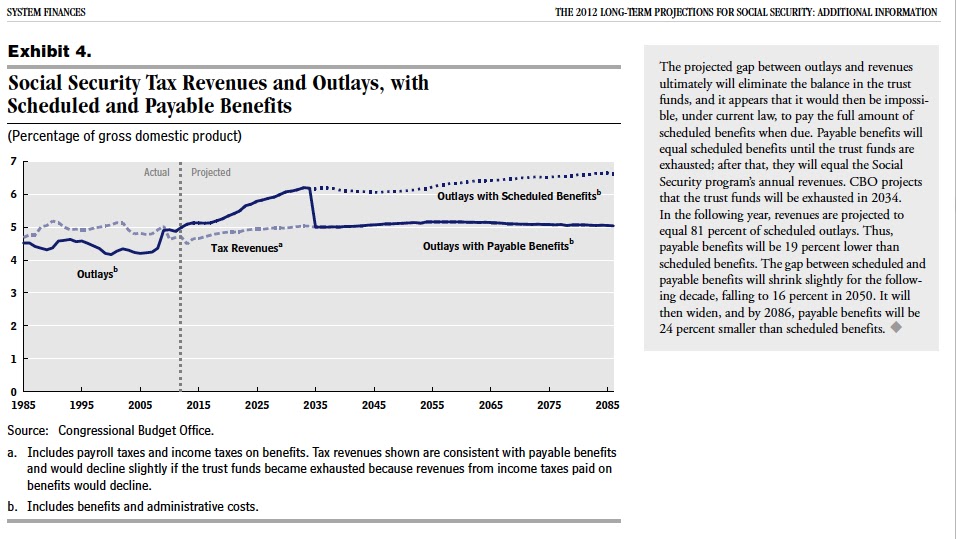
When it comes to Social Security there are three definitions of 'Solvency', one used by the 'Actuary' another by the 'Defender' and the third by the 'Reformer'. And it is this difference that lays at the heart of the policy disagreements on how to achieve it. Something ostensibly all three seek.
For the 'Actuary' 'Solvency' is mostly a value free concept. Social Security is solvent when all income from all sources equals all costs leaving Trust Fund assets equalling 100% of the next years projected cost. This is known as having a 'Trust Fund Ratio' of 100. If the Trust Funds are projected to be solvent for the upcoming 10 year window Social Security is judged to be in 'Short Term Actuarial Balance'. If the Trust Funds are projected to maintain that solvency, or at least end up with it without going into the hole over a 75 year period it is judged to be in 'Long Term Actuarial Balance'. And since 2003 the Trustees added an additional measure of solvency measured over the 'Infinite Future Horizon'.
Under current law Social Security has a 'scheduled benefit' which is the arithmetic result of a formula calculated ultimately on the course of Real Wage increases over the worker's lifetime. It also has a 'payable benefit' based on a formula that is calculated by a combination of Real Wage setting the initial benefit, inflation setting the continuing benefit, and total wages driving the income. The details are not important for the present purpose, suffice it to say that 'scheduled benefit' is the measure of Cost while 'payable benefit' is the measure of Income minus Cost. And as such 'involvency' represents that point here Cost exceeds Income to the extent that Trust Fund assets are driven below a TF Ratio of 100. Or in an alternative formulation when those assets are driven to zero. At which time we have a scenario as depicted in the above figure: a sudden reset of payable benefits from the schedule (where they were topped off by asset redemptions) to the new payable equal to then current income from taxation.
In percentage terms that sudden reset amounts to right on 25% of then current scheduled benefits and it is that discontinuity that defines 'solvency crisis'. But here is where 'defenders' and 'reformers' depart.
For Social Security Defenders the crisis is one of a cut in benefits and the solution is putting in place policy that would maintain the scheduled benefit. For Social Security 'reformers' the crisis is more political, the risk that a reset in benefits from 'scheduled' to 'payable' will result in demands that the schedule be maintained via transfers from outside the dedicated income stream of FICA and tax on benefits. As a result the proposed solutions to this same 'solvency crisis' via benefit reset are diametrically opposed with defenders advocating measures to maintain current scheduled benefits while reformers see their task as reconciling future retirees to accepting then payable.
The key here, and the stopping point for this post is that either the prescription of the defender in saving scheduled or the reformer in reconciling retirees with payable will, if accomplished by appropriate changes in current law, satisfy the actuary's test for solvency. As will outcomes in between. From a purely technocratic standpoint any set of policies that has scheduled and payable share the same ultimate projected line with no discontinuity meets the 'solvency' test. Meaning that each has 'fixed' Social Security by 'preserving' benefits in a 'sustainable' fashion. Without at any point addressing the question of whether the resulting benefits actually meet any standard of societal inequity.
Are cuts to scheduled actually the 'Road to Catfood' or a 'Concession to Reality'? Well interestingly neither question has anything to do which the metric of 'Solvency'. The question, while of course of the utmost importance in real terms, is somewhat orthogonal to discussions revolving around 'actuarial balance'. Because from the latter perspective the 'crisis' IS the 'discontinuity' and not the real world implications thereof. And a 'fix' is a 'fix'.
Saturday, December 29, 2012
CBO: SS Scheduled vs Payable Benefits (Rosser's Equation illustrated)

'Rosser's Equation' is something between an in-joke and tribute to Prof. Barkley Rosser, Jr of JMU, an economist friend of mine who pointed out a surprising result: real payable benefits after projected Trust Fund depletion and subsequent 25% cut will still be higher in actual basket of goods terms than those of current retirees. This is because the scheduled benefit formula delivers something like 160% of the current benefit and as Prof Rosser pointed out to me long ago 75% of 160%=120%.
The above Exhibit 9 from CBO's 2012 Long Term Projections for Social Security resolves Rosser's equation for selected demographic cohorts and income quintiles. And the results show that the retiree born in 1947 who reached FRA (Full Retirement Age) in 2012 would see an initial benefit ranging from $10k to $25k and representing 100% of the schedule. On the other hand the retiree born in 1970 and who will reach FRA at age 67 in 2037, that is after TF Depletion would see initial benefits in 2012 dollars ranging from $12k to $33k.
Now there is no doubt that an overnight 25% cut in benefits at Trust Fund Depletion would represent huge sticker shock for then retirees. And there are very good reasons based in societal equity for scheduled benefits to rise at the real rate the formula delivers. As such we should make every effort to find ways of closing the gap between payable and scheduled from the bottom up rather than forcing scheduled down simply to avoid the shock of of cut. Because the risk is that the 'cure' might deliver a worse result in real terms than the 'crisis' left unaddressed.
Which is why I have been maintaining for years that 'Nothing' IS a Plan. Not as good a plan as it was when Prof Rosser and I started corresponding five plus years ago, circumstances have changed. Still it represents the "First Do No Harm" alternative, after all a check in 2040 20% better in real terms than an equivalently situated retiree gets today doesn't exactly meet the definition of existential crisis for Social Security.
Friday, December 28, 2012
Google Integration for SocSecDefender
Well this in the light of an experiment. The admin/owner of the Social Security Defender blog has the e-mail address of SocSec dot Defender at GMail.com which in turn supports a Google+ social sharing site, a Google Drive, and as of just now a Google Group under the name SocialSecurityDefenders@googlegroups.com. And all of this is loose association wit the Social Security Defenders Group on dKos.
How does this work? Well I am hoping to use the SocialSecurityDefenders Group as the key to viewing files stored on shared folders in the SocSec.Defender Google Drive. And members of the Group would substantially overlap with Circles on the Google+ site. The goal is to make viewing and sharing files across the entire Social Security Defender Google space one-stop and transparent. Once someone is added to the Group they would get immediate access to files on both the Group and the Google Drive and then be added to the appropriate Circle on Google+.
I guess we will see how it goes. Early adopters can ask to join the Group by e-mailing SocSec dot Defender at GMail, aka Bruce Webb.
How does this work? Well I am hoping to use the SocialSecurityDefenders Group as the key to viewing files stored on shared folders in the SocSec.Defender Google Drive. And members of the Group would substantially overlap with Circles on the Google+ site. The goal is to make viewing and sharing files across the entire Social Security Defender Google space one-stop and transparent. Once someone is added to the Group they would get immediate access to files on both the Group and the Google Drive and then be added to the appropriate Circle on Google+.
I guess we will see how it goes. Early adopters can ask to join the Group by e-mailing SocSec dot Defender at GMail, aka Bruce Webb.
Wednesday, December 26, 2012
SSD: New Look, New Photo, New Day (maybe)
Time for the re- re- re-launch.
The blog is now linked to a new Google account and so to a new e-mail, Google+, and Google Drive shared folders under SocSec.Defender@gmail.com. As I get time and motivation I will beef up the resource and content links.
Social Security Defender, aka Bruce Webb
The blog is now linked to a new Google account and so to a new e-mail, Google+, and Google Drive shared folders under SocSec.Defender@gmail.com. As I get time and motivation I will beef up the resource and content links.
Social Security Defender, aka Bruce Webb
Sunday, December 16, 2012
Social Security Defender reborn?
Well this blog didn't go much of anywhere because it got subsumed by the dKos Social Security DefenderS Group. Which is going strong, although with not a lot of new material by me. But if and when I put up some new Social Security posts at dKos or Angry Bear I will try to cross-post them here.
In the meantime I have a new single purpose e-mail account (wait for it!) under SocSec.Defender@gmail.com. So any SS related questions can be directed there.
In the meantime I have a new single purpose e-mail account (wait for it!) under SocSec.Defender@gmail.com. So any SS related questions can be directed there.
Thursday, January 6, 2011
Debt Limit Bill and Social Security Benefit Cuts
Well the first line of attack is opening up. Lindsay Graham is threatening to hold up the Debt Limit Increase Bill, and so potentially throw this whole country and perhaps the world into default unless he gets cuts to Social Security.
This is insane on several levels, not least because the two things have nothing to do with each other to start with. To understand this we have to back off and examine four different categories of debt: Public Debt, Debt Held by the Public, Intragovernmental Holdings, and Debt Subject to the Limit. Total Public Debt and Debt Subject to the Limit are essentially the same dollar figures (an explanation of the difference here: http://www.treasurydirect.gov/govt/resources/faq/faq_publicdebt.htm#LimitDifferences), so when you compare the dollar total for the former from this link with the current limit as reported in the papers you can see how close we are: Debt to the Penny. So yes something needs to be done, but how does Social Security fit in?
It doesn't. As you can see 'Public Debt' is the sum of 'Debt Held by the Public' and 'Intragovernmental Holdings' which latter includes the current $2.6 trillion Social Security Trust Funds. But cutting Social Security benefits in the short to medium term just makes Public Debt GO UP (or at under some formulations stay even).
If Social Security on a combined basis (OASDI) or for either component (OAS or DI) takes in more in taxes than it spends those surplus dollars plus interest on the existing Trust Fund get credited to the Funds in the forms of Special Treasuries. But those assets, though real as any other bond, also respesent obligations and so add to Debt Subject to the Limit. Meaning that any action that reduces the flow out in the form of benefit cuts/retirement age or increase the flow in via cap increases simply add to the bottom line and so make the country reach the Debt Limit FASTER. Now some big name economists say this isn't really true, that instead the net effect is a wash. Well okay, I don't buy it thinking they have confused an textbook accounting identity for a real world operation, but either way cutting Social Security benefit cuts DOES NOT HELP IN ANy WAy WITH THE DEBT LIMIT.
It is not clear whether Lindsay Graham understands that he is simply holding the world's economy and the retirement benefits of millions of people in the future hostage to a simple hatred of the New Deal. But no one else should be fooled, cuts to Social Security and particularly phased in cuts in future decades have nothing to do with U.S. actual debt obligations in Spring 2010. It is pure blackmail.
This is insane on several levels, not least because the two things have nothing to do with each other to start with. To understand this we have to back off and examine four different categories of debt: Public Debt, Debt Held by the Public, Intragovernmental Holdings, and Debt Subject to the Limit. Total Public Debt and Debt Subject to the Limit are essentially the same dollar figures (an explanation of the difference here: http://www.treasurydirect.gov/govt/resources/faq/faq_publicdebt.htm#LimitDifferences), so when you compare the dollar total for the former from this link with the current limit as reported in the papers you can see how close we are: Debt to the Penny. So yes something needs to be done, but how does Social Security fit in?
It doesn't. As you can see 'Public Debt' is the sum of 'Debt Held by the Public' and 'Intragovernmental Holdings' which latter includes the current $2.6 trillion Social Security Trust Funds. But cutting Social Security benefits in the short to medium term just makes Public Debt GO UP (or at under some formulations stay even).
If Social Security on a combined basis (OASDI) or for either component (OAS or DI) takes in more in taxes than it spends those surplus dollars plus interest on the existing Trust Fund get credited to the Funds in the forms of Special Treasuries. But those assets, though real as any other bond, also respesent obligations and so add to Debt Subject to the Limit. Meaning that any action that reduces the flow out in the form of benefit cuts/retirement age or increase the flow in via cap increases simply add to the bottom line and so make the country reach the Debt Limit FASTER. Now some big name economists say this isn't really true, that instead the net effect is a wash. Well okay, I don't buy it thinking they have confused an textbook accounting identity for a real world operation, but either way cutting Social Security benefit cuts DOES NOT HELP IN ANy WAy WITH THE DEBT LIMIT.
It is not clear whether Lindsay Graham understands that he is simply holding the world's economy and the retirement benefits of millions of people in the future hostage to a simple hatred of the New Deal. But no one else should be fooled, cuts to Social Security and particularly phased in cuts in future decades have nothing to do with U.S. actual debt obligations in Spring 2010. It is pure blackmail.
Oof. A LOT of Mananas
Well lots of things didn't go as planned on the blogging front. And not because I was watching football, it was just kind of cold and blah here all around. Plus I don't know if this site will be the ultimate platform for all this, chances are good it will mostly get migrated over to dKos, or at least the blog posts, I suspect this place will always be on the back end as a place to stash links and docs.
Sunday, December 26, 2010
Getting back to business! (Manana)
A little holiday hiatus. And I am going to get my nose back on the grindstone! Just maybe not today (Sunday). Apropos of nothing my Mom got me a full spectrum light to ward off the mid-winter blues. And speaking of Blue this is a picture of my U of Calif Berkeley alter ego enjoying that light.

Tuesday, December 21, 2010
The 2% (non) Solution: Part Two
In Part One of this post I discussed the danger that the 2% 'temporary' payroll tax cut might be a Trojan Horse destined never to expire in full or at all only to have any continuing backfill from the General Fund (by then surely to be described as a 'subsidy') subject to an ongoing series of 'compromises' that gradually phase in benefit cuts rather than take the whole thing at one gulp.
In Part Two I want to discuss a quite different threat. In this scenario the employee share of the payroll tax is allowed to reset to it 6.2% but as a seeming sweetener taxpayers will be allowed or perhaps required to divert it into a Personal Savings Account with the explanation that it really wasn't a tax increase at all! Nope the money is still 'yours', just tucked away for your own future use rather than being co-mingled in the Trust Funds where you don't have an ownership interest at all, why the Supreme Court said so in Flemming .v. Nestor. Well a visit to the link shows that this doesn't mean what opponents often take it to mean, and the idea that the PRAs would be in any fundamental sense different is illusory, but before getting to that I want to point out a curious coincidence (or not). The 2% payroll tax holiday is the same amount of diversion proposed in most straight PRA proposals out there. Cynical people might suggest that this number was not just plucked out of the air, or back computed to approximate the typical effect of the expiring Make Work Pay tax credit which it is replacing, but instead to put in place elements of say Obama advisor Jeff Liebman's Liebman-MacGuineas-Samwick Non-Partisan Social Security Reform Plan or even the more recent Galston-MacGuineas Plan which has a mandatory diversion of exactly this amount.
I had a long day of Social Security related blogging and assignments and need to get this cross-posted so I'll leave it here for now. Comments on PRAs generally or Galston-MacGuineas specifically are certainly in order.
In Part Two I want to discuss a quite different threat. In this scenario the employee share of the payroll tax is allowed to reset to it 6.2% but as a seeming sweetener taxpayers will be allowed or perhaps required to divert it into a Personal Savings Account with the explanation that it really wasn't a tax increase at all! Nope the money is still 'yours', just tucked away for your own future use rather than being co-mingled in the Trust Funds where you don't have an ownership interest at all, why the Supreme Court said so in Flemming .v. Nestor. Well a visit to the link shows that this doesn't mean what opponents often take it to mean, and the idea that the PRAs would be in any fundamental sense different is illusory, but before getting to that I want to point out a curious coincidence (or not). The 2% payroll tax holiday is the same amount of diversion proposed in most straight PRA proposals out there. Cynical people might suggest that this number was not just plucked out of the air, or back computed to approximate the typical effect of the expiring Make Work Pay tax credit which it is replacing, but instead to put in place elements of say Obama advisor Jeff Liebman's Liebman-MacGuineas-Samwick Non-Partisan Social Security Reform Plan or even the more recent Galston-MacGuineas Plan which has a mandatory diversion of exactly this amount.
I had a long day of Social Security related blogging and assignments and need to get this cross-posted so I'll leave it here for now. Comments on PRAs generally or Galston-MacGuineas specifically are certainly in order.
Monday, December 20, 2010
The 2% (non) Solution: Part One
As part of the Tax Cut deal Obama cut with Republicans there was included a one-year cut of 2% of payroll out of the 6.2% employee share of the overall 12.4% of payroll sent to Social Security. This cut was ostensibly designed in a way that held harmless the Trust Funds, the dollars not being sent from paychecks instead being replaced by transfers from the General Fund. Plus the diversion is on paper only temporary. But in reality this deal not only should have raised red flags, it also should have blown reveille and set off the disaster warning klaxons. This deal represents a terrible danger to Social Security in at least two ways and is terrible policy besides.
If the so-called Payroll Tax Holiday stood on its own, you could argue that it is mildly progressive in that for one year it reduced the taxes of everyone on their first $106,800 of income while paying for it out of taxes that are mostly incident on the top 50%. Unfortunately it effectively replaced the expiring Making Work Pay tax credit which directed all of its benefits to families making at most $70,000. The net result may be a tax hike for as many as one in three workers. The whole grim business is described in this Huff Post piece: Obama-Republican Deal Could Mean Tax Hike For One In Three Workers by the appropriately named Ryan Grim. From my point of view the fact that the tradeoff was suggested by Republicans is all you need to know, millionaires will get a tax cut ten times of that of a single person working at FPL in a minimum wage job.
However this particular issue, however important from an economic justice and income inequality standpoint is somewhat peripheral to Social Security itself. And there are plenty of people more qualified than me to comment on it, starting with Mr. Grim, so over to them on this one. Instead I want to discuss two threats posed to Social Security, one that just brings the funding shortfall much closer in time and is pretty well recognized, and a second that is more subtle but presents an existential threat to Social Security itself.
The first threat is fairly simply stated: in today's Washington D.C. there is no such thing as a 'temporary' tax cut. As long as Republicans have anything to say about it (and since they are effectively calling the shots even before they take control of even the House) there is no such thing as restoration of existing levels of taxation after a 'tax holiday', instead any such cuts will be presented as a tax increase, in this case a massive one. Because they can and will play games with percentages. That is while the cut is presented as 'only' 2% and so to reasonable minds would seem a small part of the revenue flow, it represents 16% of the total revenue flow generated by FICA payroll tax and a whopping 32% of that taken out of workers' paychecks. Moreover taking the employee share simply back to 2010 levels means an increase from 4.2% to 6.2% or a whopping 47% TAX INCREASE. That is you can expect Obama to get headline credit for a 2% cut but get blamed for a near 50% increase even though it is the same dollars in question.
The anticipated rhetorical spin is only the start of the danger. Social Security Title 2 (what we know as Soc Sec today) has always been a closed system, to paraphrase Lincoln 'of the worker, by the worker, and for the worker', having taken nothing directly from capital it owed nothing to capital. Moreover because of the way that its dedicated taxation and later benefit levels were set up it was largely insulated from the Budget and Appropriations process. While opponents of Social Security could and did play games with the 1% of cost related to Administration, an amount that is exposed to those processes, that game playing didn't put the whole system at risk (though it caused a lot of misery on the Disability Insurance side, where Admin has always been scandalously underfunded). But in 2011 a very substantial chunk of Social Security income will come from the General Fund. And while it is always possible that the next Congress will just ease that General Fund burden by letting the 'holiday' lapse on schedule there is no guarantee that they wouldn't simply leave the 4.2% rate in place while cutting the subsidy from the General Fund and so blowing around a $120 billion hole in the income stream for 2012 and every year after. With the net effect of bringing the projected date of Trust Fund depletion back dramatically from its current 2037 date, perhaps as early as 2020.
Of course this might appear just too raw and hypocritical for the Republicans, that after crying 'crisis' they did what they could to precipitate it, but it opens the door for other chicanery. For example the Republicans could offer to leave the 4.2% rate in place, lower the replacement subsidy by 50% and 'compromise' by cutting future benefits in a way that offsets the other 50%. And then just repeat this exercise every year in their typical framing of separating "spending we CAN'T afford" (which always seems to be social spending) from "spending we can't NOT afford" (which seems to be everything military and any efforts to raise revenues).
Social Security has been protected throughout its history by the wall represented by a dedicated payroll tax and a Trust Fund whose reserves were drawn from that same stream. This Administration just breached that wall, apparently in the futile attempt to show 'seriousness' and 'bipartisanship' which in this case translates to 'willingness to screw your own base'.
This payroll tax holiday was a terrible policy choice to start with, continuation of Making Work Pay or direct transfers from the General Fund to workers would have been more effective and better targeted stimulus than a tax cut that also flows to millionaires. But the danger is not restricted to the direct breach in the wall. Instead there is a lurking Trojan Horse. Subject of Part Two.
If the so-called Payroll Tax Holiday stood on its own, you could argue that it is mildly progressive in that for one year it reduced the taxes of everyone on their first $106,800 of income while paying for it out of taxes that are mostly incident on the top 50%. Unfortunately it effectively replaced the expiring Making Work Pay tax credit which directed all of its benefits to families making at most $70,000. The net result may be a tax hike for as many as one in three workers. The whole grim business is described in this Huff Post piece: Obama-Republican Deal Could Mean Tax Hike For One In Three Workers by the appropriately named Ryan Grim. From my point of view the fact that the tradeoff was suggested by Republicans is all you need to know, millionaires will get a tax cut ten times of that of a single person working at FPL in a minimum wage job.
However this particular issue, however important from an economic justice and income inequality standpoint is somewhat peripheral to Social Security itself. And there are plenty of people more qualified than me to comment on it, starting with Mr. Grim, so over to them on this one. Instead I want to discuss two threats posed to Social Security, one that just brings the funding shortfall much closer in time and is pretty well recognized, and a second that is more subtle but presents an existential threat to Social Security itself.
The first threat is fairly simply stated: in today's Washington D.C. there is no such thing as a 'temporary' tax cut. As long as Republicans have anything to say about it (and since they are effectively calling the shots even before they take control of even the House) there is no such thing as restoration of existing levels of taxation after a 'tax holiday', instead any such cuts will be presented as a tax increase, in this case a massive one. Because they can and will play games with percentages. That is while the cut is presented as 'only' 2% and so to reasonable minds would seem a small part of the revenue flow, it represents 16% of the total revenue flow generated by FICA payroll tax and a whopping 32% of that taken out of workers' paychecks. Moreover taking the employee share simply back to 2010 levels means an increase from 4.2% to 6.2% or a whopping 47% TAX INCREASE. That is you can expect Obama to get headline credit for a 2% cut but get blamed for a near 50% increase even though it is the same dollars in question.
The anticipated rhetorical spin is only the start of the danger. Social Security Title 2 (what we know as Soc Sec today) has always been a closed system, to paraphrase Lincoln 'of the worker, by the worker, and for the worker', having taken nothing directly from capital it owed nothing to capital. Moreover because of the way that its dedicated taxation and later benefit levels were set up it was largely insulated from the Budget and Appropriations process. While opponents of Social Security could and did play games with the 1% of cost related to Administration, an amount that is exposed to those processes, that game playing didn't put the whole system at risk (though it caused a lot of misery on the Disability Insurance side, where Admin has always been scandalously underfunded). But in 2011 a very substantial chunk of Social Security income will come from the General Fund. And while it is always possible that the next Congress will just ease that General Fund burden by letting the 'holiday' lapse on schedule there is no guarantee that they wouldn't simply leave the 4.2% rate in place while cutting the subsidy from the General Fund and so blowing around a $120 billion hole in the income stream for 2012 and every year after. With the net effect of bringing the projected date of Trust Fund depletion back dramatically from its current 2037 date, perhaps as early as 2020.
Of course this might appear just too raw and hypocritical for the Republicans, that after crying 'crisis' they did what they could to precipitate it, but it opens the door for other chicanery. For example the Republicans could offer to leave the 4.2% rate in place, lower the replacement subsidy by 50% and 'compromise' by cutting future benefits in a way that offsets the other 50%. And then just repeat this exercise every year in their typical framing of separating "spending we CAN'T afford" (which always seems to be social spending) from "spending we can't NOT afford" (which seems to be everything military and any efforts to raise revenues).
Social Security has been protected throughout its history by the wall represented by a dedicated payroll tax and a Trust Fund whose reserves were drawn from that same stream. This Administration just breached that wall, apparently in the futile attempt to show 'seriousness' and 'bipartisanship' which in this case translates to 'willingness to screw your own base'.
This payroll tax holiday was a terrible policy choice to start with, continuation of Making Work Pay or direct transfers from the General Fund to workers would have been more effective and better targeted stimulus than a tax cut that also flows to millionaires. But the danger is not restricted to the direct breach in the wall. Instead there is a lurking Trojan Horse. Subject of Part Two.
Sunday, December 19, 2010
If this is the Defense, Who is On Offense?
Well like Santa I'll be "making a list and checking it twice" and then naming names. Because one function of this project is to act as a clearinghouse to push back on the organized groups and think thanks that are leading the charge for 'reform' of Social Security. But in this post I just want to call out some categories. Because the motivations are not all the same even as they overlap and if you had to call out some key words it would be the three 'S's: socialism, simoleons, sustainability.
Socialism: There are a number of folk who simply oppose government run social and economic programs. Throwing out some labels this would include many Burkean Conservatives, Constitutional Originalists, Libertarians of all stripes and particularly those who ally themselves with the Austrian School. Their objects range from the purely philosophical to operational 'slippery slope' arguments (The Road to Serfdom (by Friedrich von Hayek), but mostly their argument boils down to a simple equation: Socialism = Redistribution. This is often but not always overlayed with an argument with Calvinist roots, that charity should be voluntary and directed to the 'deserving' poor, and not the 'undeserving' poor who we could identify as Marx's Lumpenproletariat. But there are plenty of atheists in this group as well, it is here that you will find followers of Randian Objectivism.
With this group two typical push back methods are totally ineffective, one being appealing to that brand of Christian and other faith thought that finds an exemplar in the Sermon on the Mount and the other any argument that the cost of saving Social Security as is, or following Prof. Jamie Galbraith, the late Bob Ball, and others of enhancing its benefits. On the religious front they are either indifferent or have it covered via voluntary charity to the 'deserving' and on the economic front their problem is not that Social Security is going broke or that its benefits are too skimpy but that the program exists at all. Now theoretically you can get to this group by proving that current methods for original distribution of the gains from productivity are unfair and that methods to redress that are akin the governments power to enforce property rights. And in taking this approach you could take advantage of the fact that a substantial sector of this group has always been distrustful of Central Banking and bankers in general. By and large though this is a hard headed lot and have combined elements of Calvinism, Horatio Alger, and Milton Friedman into a belief that Capitalism works if you do, that in almost all cases you can and should provide for your own economic well being through savings and investment. Which is why they generally favor a transition away from traditional Social Security to some form of personal/private retirement accounts.
Simoleons. One school of thought among the defenders of Social Security believe that in the end this is all being driven by Wall Street, that the Masters of the Universe are driven to near madness seeing a huge stream of money flowing over which they have no control and for which they would love to charge fees. Often this is posed in the form that they covet the $2.6 trillion in assets in the Social Security Trust Funds. Personally I have never put much stock in this theory. For one thing it relies on a misunderstanding of the nature of those assets, and ignores the projected state of cash flow going forward.
Now there was a time when this was a viable strategy. In 1993 the changes to Social Security implemented pursuant to the Greenspan Commission compromise had restored the system to its official measure of short-term solvency, a Trust Fund Ratio of 100, meaning reserves of Treasuries equal to one year of projected cost. (The following table from the 2010 Report is worth extended study, I will be returning to it again and again: Table VI.A4.— Operations of the Combined OASI and DI Trust Funds, Calendar Years 1957-2009). 1993 market the point when Social Security entered what was projected, and eventuated, as a 20+ year series of primary surpluses, meaning receipts from contributions and taxation and excluding interest, i.e. actual cash flow, in growing excess of cost. This window was always projected to close as the large demographic cohort of Boomers reached Early Retirement eligibility starting in 2008, and Full Retirement eligibility starting 2012, but in the meanwhile there was an opportunity to invest those primary surpluses in other asset classes with returns that under some optimistic forecasts would exceed those of interest on Treasuries sufficient to justify the fees extracted by account managers. Whether this would have actually worked has been a subject of on-going debate since then but the operative words are 'was' and 'would', not only has that window largely closed the current downturn made the cloture a little faster, for all practical purposes the days of primary surpluses are over and with them the possibility of extracting large fees from Personal Accounts. Which explains why most of the current pressure on Social Security for private accounts is not being led from Wall Street, but from ideologically driven think tanks and individuals. The Cash Cow has dried up.
Sustainability. Historically Social Security has been extraordinarily popular among the population at large, so much so that it gained the appellation of "The Third Rail of American Politics": touch it and you die. This meant that direct attacks on it along the lines suggested in 'Socialism' above mostly did not resonate except among the true believers. And the argument for Privatization outlined in 'Simoleons' collapsed in the course of the 2005 Bush's 'Social Security Tour's failure in the light of the There is No Crisis, and was sealed with the economic collapse starting in 2007-2008. Which has required an almost total shift among opponents of traditional Social Security to what was a primary line of attack all along, that however popular and well-intended Social Security might have been, its benefits were over generous looking back and unaffordable going forward. Well both of those propositions are doubtful on examination, and the good will of those pushing them are to say the least suspect, it being pretty clear that most people in the 'Unsustainable' camp are really driven by one or the other of the two 'S's above. Subject of future posts.
Socialism: There are a number of folk who simply oppose government run social and economic programs. Throwing out some labels this would include many Burkean Conservatives, Constitutional Originalists, Libertarians of all stripes and particularly those who ally themselves with the Austrian School. Their objects range from the purely philosophical to operational 'slippery slope' arguments (The Road to Serfdom (by Friedrich von Hayek), but mostly their argument boils down to a simple equation: Socialism = Redistribution. This is often but not always overlayed with an argument with Calvinist roots, that charity should be voluntary and directed to the 'deserving' poor, and not the 'undeserving' poor who we could identify as Marx's Lumpenproletariat. But there are plenty of atheists in this group as well, it is here that you will find followers of Randian Objectivism.
With this group two typical push back methods are totally ineffective, one being appealing to that brand of Christian and other faith thought that finds an exemplar in the Sermon on the Mount and the other any argument that the cost of saving Social Security as is, or following Prof. Jamie Galbraith, the late Bob Ball, and others of enhancing its benefits. On the religious front they are either indifferent or have it covered via voluntary charity to the 'deserving' and on the economic front their problem is not that Social Security is going broke or that its benefits are too skimpy but that the program exists at all. Now theoretically you can get to this group by proving that current methods for original distribution of the gains from productivity are unfair and that methods to redress that are akin the governments power to enforce property rights. And in taking this approach you could take advantage of the fact that a substantial sector of this group has always been distrustful of Central Banking and bankers in general. By and large though this is a hard headed lot and have combined elements of Calvinism, Horatio Alger, and Milton Friedman into a belief that Capitalism works if you do, that in almost all cases you can and should provide for your own economic well being through savings and investment. Which is why they generally favor a transition away from traditional Social Security to some form of personal/private retirement accounts.
Simoleons. One school of thought among the defenders of Social Security believe that in the end this is all being driven by Wall Street, that the Masters of the Universe are driven to near madness seeing a huge stream of money flowing over which they have no control and for which they would love to charge fees. Often this is posed in the form that they covet the $2.6 trillion in assets in the Social Security Trust Funds. Personally I have never put much stock in this theory. For one thing it relies on a misunderstanding of the nature of those assets, and ignores the projected state of cash flow going forward.
Now there was a time when this was a viable strategy. In 1993 the changes to Social Security implemented pursuant to the Greenspan Commission compromise had restored the system to its official measure of short-term solvency, a Trust Fund Ratio of 100, meaning reserves of Treasuries equal to one year of projected cost. (The following table from the 2010 Report is worth extended study, I will be returning to it again and again: Table VI.A4.— Operations of the Combined OASI and DI Trust Funds, Calendar Years 1957-2009). 1993 market the point when Social Security entered what was projected, and eventuated, as a 20+ year series of primary surpluses, meaning receipts from contributions and taxation and excluding interest, i.e. actual cash flow, in growing excess of cost. This window was always projected to close as the large demographic cohort of Boomers reached Early Retirement eligibility starting in 2008, and Full Retirement eligibility starting 2012, but in the meanwhile there was an opportunity to invest those primary surpluses in other asset classes with returns that under some optimistic forecasts would exceed those of interest on Treasuries sufficient to justify the fees extracted by account managers. Whether this would have actually worked has been a subject of on-going debate since then but the operative words are 'was' and 'would', not only has that window largely closed the current downturn made the cloture a little faster, for all practical purposes the days of primary surpluses are over and with them the possibility of extracting large fees from Personal Accounts. Which explains why most of the current pressure on Social Security for private accounts is not being led from Wall Street, but from ideologically driven think tanks and individuals. The Cash Cow has dried up.
Sustainability. Historically Social Security has been extraordinarily popular among the population at large, so much so that it gained the appellation of "The Third Rail of American Politics": touch it and you die. This meant that direct attacks on it along the lines suggested in 'Socialism' above mostly did not resonate except among the true believers. And the argument for Privatization outlined in 'Simoleons' collapsed in the course of the 2005 Bush's 'Social Security Tour's failure in the light of the There is No Crisis, and was sealed with the economic collapse starting in 2007-2008. Which has required an almost total shift among opponents of traditional Social Security to what was a primary line of attack all along, that however popular and well-intended Social Security might have been, its benefits were over generous looking back and unaffordable going forward. Well both of those propositions are doubtful on examination, and the good will of those pushing them are to say the least suspect, it being pretty clear that most people in the 'Unsustainable' camp are really driven by one or the other of the two 'S's above. Subject of future posts.
Thursday, December 16, 2010
Spider and Bear: Early Versions of Soc Sec 101
My first foray into Social Security blogging (as opposed to commenting on other blogs) was with the launch of The Bruce Web in Nov 2004, or immediately after then President Bush announced he was going to use his "capital" to "reform" Social Security. The Bruce Web was mostly designed as a place to stash links and to work out some of my thinking, but the result was kind of a mini-course on Social Security finance as it looked at the time. The economic outlook is a lot different today and I won't be writing the new series of posts in quite the same way, but the fundamentals haven't changed and new students of Social Security could do worse than checking out the: 2004 archives including the one that explains how I got onto this topic to begin with: Trust Fund Exhaustion: a Personal Odyssey.
From 2004 through the 'There is No Crisis' movement of 2005 right to 2008 I was an active participant in every Social Security thread on every political and economics blog I ran across, and in time built enough cred that in May 2008 I was invited to write a Social Security series for the econoblog Angry Bear. The immediate result of that was a series of 44 numbered posts that I indexed back on my own site: Angry Bear Social Security Series
One main purpose of this new site is to rework the Nov 2004 and May-June 2008 series in light of the new (and grimmer) realities of the current recession/depression. Social Security is STILL not broken, but it CAN be broken by its enemies, and the push back against that is really what this site will be all about.
From 2004 through the 'There is No Crisis' movement of 2005 right to 2008 I was an active participant in every Social Security thread on every political and economics blog I ran across, and in time built enough cred that in May 2008 I was invited to write a Social Security series for the econoblog Angry Bear. The immediate result of that was a series of 44 numbered posts that I indexed back on my own site: Angry Bear Social Security Series
One main purpose of this new site is to rework the Nov 2004 and May-June 2008 series in light of the new (and grimmer) realities of the current recession/depression. Social Security is STILL not broken, but it CAN be broken by its enemies, and the push back against that is really what this site will be all about.
Wednesday, December 15, 2010
Social Security Defender Launch
Well I secured a small grant that will allow me to take this site and the overall effort to the next level. I don't know if this site will remain as a stand-alone blog or whether it will be effectively ported over to a bigger stage, for example at the upcoming dKos 4 blogging platform.
The next steps are to launch Social Security 101 and to steal a phrase from Atrios to "document the atrocities on right economic websites. But before that I am going to go out and upgrade my presentation and web design software to more professional standards.
The next steps are to launch Social Security 101 and to steal a phrase from Atrios to "document the atrocities on right economic websites. But before that I am going to go out and upgrade my presentation and web design software to more professional standards.
Subscribe to:
Posts (Atom)