FDR signing the 1935 SS Act (click image for person key)

Thursday, January 3, 2013

2013 Debt and Deficit Toolkit: Part 1

(Crossposted from Angry Bear All of the terms in the post title have at least two usages, some of which map upon to common sense ideas from business or household budgeting, some not. Unfortunately the usages that don't tend to be those used in federal budget reporting, and the result is untold confusion. Now one way out would be to listen to me. Then again the relevant line on my CV under 'Budget Reporting' reads 'Some Guy', 'U of Intertoobz'. So really the only way out is to start to build your own Budget, Debt and Deficit Toolkit. And this post is intended to give you a start using sources provided by the official scorekeepers of such things: the U.S. Treasury, the Congressional Budget Office (CBO), the President's Office of Management and Budget (OMB) and the Joint Committee on Taxation (JCT).

First stop is the U.S. Treasury Department's Bureau of Public Debt and their web application Debt to the Penny. This handy application allows you to track Total Public Debt and its two components Debt Held by the Public and Intragovernmental Holdings to the literal penny as of the close of the daily books the last business day but one. That is if you check the site on Tuesday it will give you final numbers for Friday. And a search today gave me the results for Monday the 31st (since Tuesday was a Federal Holiday) with Total Public Debt of $16,432,730,050,569.12 . This number is almost exactly the same as Debt Subject to the Limit differing only in the last seven or eight digits, which change so fast that you wouldn't be able to see the difference. Debt Subject to the Limit is set by Congress and under current law is $16.394 trillion. With the result shown in the following official graph Debt Subject to the Limit Graph which shows total Public Debt Subject to the Limit (dark blue) passing through the Limit (orange) on the 31st.

Without comment (we are just building a toolkit here) we can move from Debt to Deficit. Here things get more complicated but probably the simplest tool available to us from official sources is found in CBOs annual The Budget and Economic Outlook: Fiscal Years 2012 to 2022 and the literal top line numbers from that is Summary Table 1 (click to embiggen)
Note that in this Summary table the bolded words Deficit (-) or Surplus unmodified by any adjective are unequivocably the sum of 'On-budget' and 'Off-budget' surplus/deficit. This isn't the only usage of 'deficit' in CBO reporting, and in a weird twist of terminology is NOT the same as what they call 'primary deficit', but it is a fair equivalent to what both CBO and the MSM term 'THE deficit'. For example take a standard news story from just today FY2011 Federal Deficit = $1,299,000,000,000 or just a minor update of the figure from the Table.

I'll flesh out some of the implications of this in Comments and in later posts but will leave with two points. One almost the entirety of the 'Off budget' surplus of $67 billion is the result of an increase in assets of the Social Security Trust Fund. It is NOT a measure of cash flow nor does cash flow measure into it. Two the claim that 'Social Security doesn't contribute to the deficit' is not quite right. It can and does contribute to the bottom line. But in either positive (surplus) or negative (deficit) directions. And in 2011 a cash flow negative Social Security Trust Fund ran a surplus for the purposes of THE federal deficit as defined.

More tools and more discussion later.

Monday, December 31, 2012

Social Security Roshomon

My first Daily Kos Social Security diary in a while:

Social Security Roshomon: an Actuary, a Defender and a Reformer Meet it begins to explore the implications of the following two figures from CBO

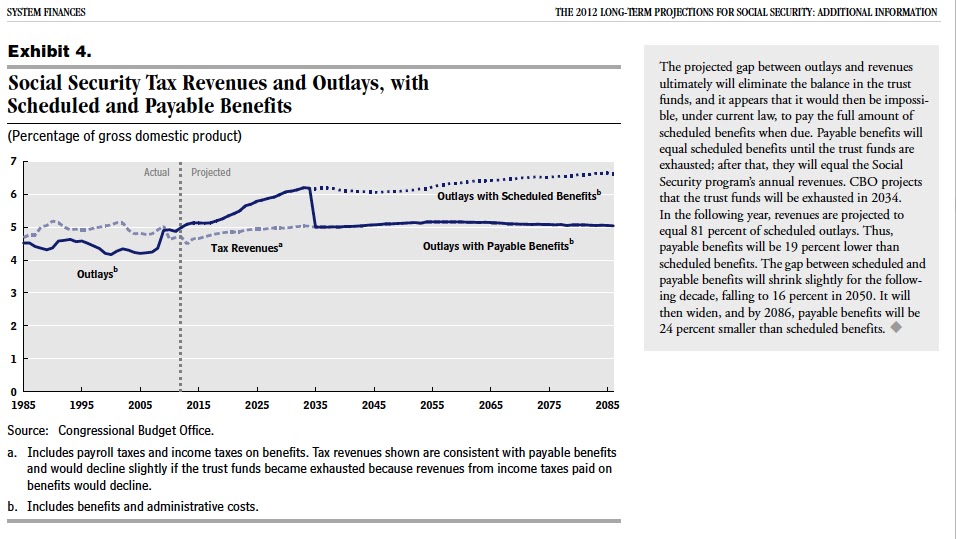
Bottom line: while Chained CPI would be an act of betrayal towards seniors who fully deserve current law scheduled benefits it still would produce a result in the dark gray of Figure 3, meaning a better basket of goods than current retirees get today. And this would likely be still be true after the reset at Trust Fund Depletion shown in Exhibit 4. That is 'Catfood' is simply a useful metaphor for Defenders, it isn't to be taken literally.

Sunday, December 30, 2012

Scheduled vs Payable Benefits: three definitions of Solvency

As usual click to embiggen.

When it comes to Social Security there are three definitions of 'Solvency', one used by the 'Actuary' another by the 'Defender' and the third by the 'Reformer'. And it is this difference that lays at the heart of the policy disagreements on how to achieve it. Something ostensibly all three seek.

For the 'Actuary' 'Solvency' is mostly a value free concept. Social Security is solvent when all income from all sources equals all costs leaving Trust Fund assets equalling 100% of the next years projected cost. This is known as having a 'Trust Fund Ratio' of 100. If the Trust Funds are projected to be solvent for the upcoming 10 year window Social Security is judged to be in 'Short Term Actuarial Balance'. If the Trust Funds are projected to maintain that solvency, or at least end up with it without going into the hole over a 75 year period it is judged to be in 'Long Term Actuarial Balance'. And since 2003 the Trustees added an additional measure of solvency measured over the 'Infinite Future Horizon'.

Under current law Social Security has a 'scheduled benefit' which is the arithmetic result of a formula calculated ultimately on the course of Real Wage increases over the worker's lifetime. It also has a 'payable benefit' based on a formula that is calculated by a combination of Real Wage setting the initial benefit, inflation setting the continuing benefit, and total wages driving the income. The details are not important for the present purpose, suffice it to say that 'scheduled benefit' is the measure of Cost while 'payable benefit' is the measure of Income minus Cost. And as such 'involvency' represents that point here Cost exceeds Income to the extent that Trust Fund assets are driven below a TF Ratio of 100. Or in an alternative formulation when those assets are driven to zero. At which time we have a scenario as depicted in the above figure: a sudden reset of payable benefits from the schedule (where they were topped off by asset redemptions) to the new payable equal to then current income from taxation.

In percentage terms that sudden reset amounts to right on 25% of then current scheduled benefits and it is that discontinuity that defines 'solvency crisis'. But here is where 'defenders' and 'reformers' depart.

For Social Security Defenders the crisis is one of a cut in benefits and the solution is putting in place policy that would maintain the scheduled benefit. For Social Security 'reformers' the crisis is more political, the risk that a reset in benefits from 'scheduled' to 'payable' will result in demands that the schedule be maintained via transfers from outside the dedicated income stream of FICA and tax on benefits. As a result the proposed solutions to this same 'solvency crisis' via benefit reset are diametrically opposed with defenders advocating measures to maintain current scheduled benefits while reformers see their task as reconciling future retirees to accepting then payable.

The key here, and the stopping point for this post is that either the prescription of the defender in saving scheduled or the reformer in reconciling retirees with payable will, if accomplished by appropriate changes in current law, satisfy the actuary's test for solvency. As will outcomes in between. From a purely technocratic standpoint any set of policies that has scheduled and payable share the same ultimate projected line with no discontinuity meets the 'solvency' test. Meaning that each has 'fixed' Social Security by 'preserving' benefits in a 'sustainable' fashion. Without at any point addressing the question of whether the resulting benefits actually meet any standard of societal inequity.

Are cuts to scheduled actually the 'Road to Catfood' or a 'Concession to Reality'? Well interestingly neither question has anything to do which the metric of 'Solvency'. The question, while of course of the utmost importance in real terms, is somewhat orthogonal to discussions revolving around 'actuarial balance'. Because from the latter perspective the 'crisis' IS the 'discontinuity' and not the real world implications thereof. And a 'fix' is a 'fix'.

Saturday, December 29, 2012

CBO: SS Scheduled vs Payable Benefits (Rosser's Equation illustrated)


'Rosser's Equation' is something between an in-joke and tribute to Prof. Barkley Rosser, Jr of JMU, an economist friend of mine who pointed out a surprising result: real payable benefits after projected Trust Fund depletion and subsequent 25% cut will still be higher in actual basket of goods terms than those of current retirees. This is because the scheduled benefit formula delivers something like 160% of the current benefit and as Prof Rosser pointed out to me long ago 75% of 160%=120%.

The above  Exhibit 9 from CBO's 2012 Long Term Projections for Social Security resolves Rosser's equation for selected demographic cohorts and income quintiles. And the results show that the retiree born in 1947 who reached FRA (Full Retirement Age) in 2012 would see an initial benefit ranging from $10k to $25k and representing 100% of the schedule. On the other hand the retiree born in 1970 and who will reach FRA at age 67 in 2037,  that is after TF Depletion would see initial benefits in 2012 dollars ranging from $12k to $33k.

Now there is no doubt that an overnight 25% cut in benefits at Trust Fund Depletion would represent huge sticker shock for then retirees. And there are very good reasons based in societal equity for scheduled benefits to rise at the real rate the formula delivers. As such we should make every effort to find ways of closing the gap between payable and scheduled from the bottom up rather than forcing scheduled down simply to avoid the shock of of cut. Because the risk is that the 'cure' might deliver a worse result in real terms than the 'crisis' left unaddressed.

Which is why I have been maintaining for years that 'Nothing' IS a Plan. Not as good a plan as it was when Prof Rosser and I started corresponding five plus years ago, circumstances have changed. Still it represents the "First Do No Harm" alternative, after all a check in 2040 20% better in real terms than an equivalently situated retiree gets today doesn't exactly meet the definition of existential crisis for Social Security.

Friday, December 28, 2012

Google Integration for SocSecDefender

Well this in the light of an experiment. The admin/owner of the Social Security Defender blog has the e-mail address of SocSec dot Defender at GMail.com which in turn supports a Google+ social sharing site, a Google Drive, and as of just now a Google Group under the name SocialSecurityDefenders@googlegroups.com. And all of this is loose association wit the Social Security Defenders Group on dKos.

How does this work? Well I am hoping to use the SocialSecurityDefenders Group as the key to viewing files stored on shared folders in the SocSec.Defender Google Drive. And members of the Group would substantially overlap with Circles on the Google+ site. The goal is to make viewing and sharing files across the entire Social Security Defender Google space one-stop and transparent. Once someone is added to the Group they would get immediate access to files on both the Group and the Google Drive and then be added to the appropriate Circle on Google+.

I guess we will see how it goes. Early adopters can ask to join the Group by e-mailing SocSec dot Defender at GMail, aka Bruce Webb.

Wednesday, December 26, 2012

SSD: New Look, New Photo, New Day (maybe)

Time for the re- re- re-launch.

The blog is now linked to a new Google account and so to a new e-mail, Google+, and Google Drive shared folders under SocSec.Defender@gmail.com. As I get time and motivation I will beef up the resource and content links.

Social Security Defender, aka Bruce Webb

Sunday, December 16, 2012

Social Security Defender reborn?

Well this blog didn't go much of anywhere because it got subsumed by the dKos Social Security DefenderS Group. Which is going strong, although with not a lot of new material by me. But if and when I put up some new Social Security posts at dKos or Angry Bear I will try to cross-post them here.

In the meantime I have a new single purpose e-mail account (wait for it!) under SocSec.Defender@gmail.com. So any SS related questions can be directed there.